|
A History of Pre-War Automotive
Tootsietoys
by Clint Seeley edited by Robert Newson Part 1 - Historical background, the 1911 Limousine and the Model T Fords Clint Seeley's original text is in green, and my editorial additions are in blue. Put your mouse over the thumbnail images to see the picture caption, and click on the thumbnail to enlarge. A history has to
begin somewhere, and one's first impulse is to try beginning at the
beginning. But that would be much too pedestrian an approach for
a piece on toy vehicles. Besides, a researcher is seldom so
lucky, and more often must begin with now
and try working his way back to the birth of his subject. But
that would make it tough on the reader. A collector's interest in
the subject is more likely to have germinated somewhere in the middle
and gradually spread both forward and backward. This approach
would almost surely drive the editor crazy, and is best avoided in the
interests of keeping alive scarce editors and the precious surviving
illustrated collector's journal in English. Perhaps I can succeed
in dissatisfying everyone by starting with the present and bouncing
backward in long skips and jumps over major corporate events, source
material, documents, and people, and then gradually returning in normal
chronological sequence, covering the actual model releases along the
way. Well, not quite. It will be a little more orderly to
take up groups of vehicles which go together in roughly proper
sequence, though members of the group may have been introduced over a
period of years. The "early" Macks are a case in point, having
been introduced over a ten-year span, and remaining ln the catalogue in
some form for nearly twenty years. Well, having laid down the
ground rules, let's get on with it.
The present owner (remember Clint was writing in 1970) of the Tootsietoy trade-mark and manufacturer of current Tootsietoys is the Strombecker Corporation. It is presided over by three brothers, Myron (Mile), Allen and Richard (Dlck) Shure. Their grandfather had been an importer and manufacturer of novelties used in the carnival and circus trade, and bought out the Dowst Brothers Company in June 1926, after which the firm changed its name to the Dowst Manufacturing Co.Inc. When this company bought out the Strombecker Corporation in January 1964, during the crest of the slot-racing fad, it took the name of the lesser firm. It then expanded into the slot-raclng area, but continued making Tootsietoys, as well as other items long in their line, such as the metal miniatures used in Monopoly games. The Dowst firm itself evolved in the last quarter of the nineteenth century. The first entry I can find in the Lakeside Directory of Chicago is in 1877, when Charles O.Dowst was listed as a book-keeper. By 1879 he was listed under Dowst & Co., publishers, and two years later as editor and proprietor of the National Laundry Journal, when he was joined by his brother, Samuel. A decade later, the listing was changed to "Laundry Supplies". The World's Columbian Exposition took place in Chicago during the summer of 1893, at which a new type-casting machine, the Line-O-Type, was introduced. It was natural that this should interest the publishing Dowsts, and one was soon installed at their plant. Before long, they recognised that this equipment could be adapted to cast more than a "Line-O-Type". Soon, laundry accessories, such as collar buttons and small promotional irons, were being turned out. This line was quickly expanded to include tiny animals, whistles, rings, ships, etc., used for prizes in boxes of candied pop-corn (Cracker-Jacks) and by confectioners in wedding and birthday cakes, etc. By 1899 the firm was listed as "Dowst Brothers Co., Confectioners' Supplies", and by 1904 as "Metal Novelties".  Two years later,
Theodore S.Dowst (the son of
Samuel Dowst)
marked the entry of the next generation as a book-keeper. He
became a most inventive contributor, patenting the later cars and
trucks in the 1920s and culminating in his patent of the Grahams in
1934. He stayed with the firm until his retirement as president
in June 1945. He lived in retirement in San Diego, California,
until his death only a few years ago
(in the 1960s). Two years later,
Theodore S.Dowst (the son of
Samuel Dowst)
marked the entry of the next generation as a book-keeper. He
became a most inventive contributor, patenting the later cars and
trucks in the 1920s and culminating in his patent of the Grahams in
1934. He stayed with the firm until his retirement as president
in June 1945. He lived in retirement in San Diego, California,
until his death only a few years ago
(in the 1960s).The 1911
Limousine
 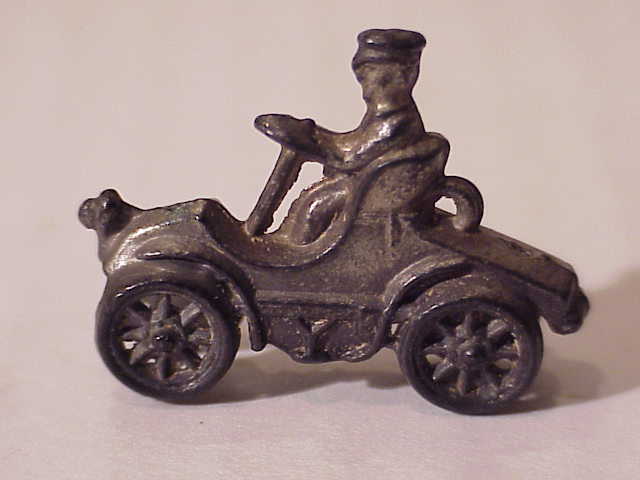 The earliest
catalogue to come to hand has been that of
1909.
There are three small miniature cars shown in it, issued as miniature
favours, charms, pins, buttons and cuff links. The earliest was
issued about 1901, and resembles a curved-dash Olds. True
three-dimensional miniature models of a train, boats and a horse-drawn
fire engine were made in the first decade of the century, but a true
model car did not appear until 1911, when a tiny closed limousine was
introduced. This remained in the catalogue through 1928. The
limousine was also cast in a version with integrally cast wheels, also
catalogued until 1928. Both versions were soon copied in
various materials and methods, including a set with the names of real
automobiles (Ford, Saxon, Paige, Dodge, Maxwell, etc.) cast on the roof
and used for tokens on game boards. Dowst had also been producing
small castings for this purpose, and made the metal shoe, iron, ship
and others for Parker Brothers' games such as Monopoly. (This
additional information is from Clint Seeley's 1984 article (ref.1)). The earliest
catalogue to come to hand has been that of
1909.
There are three small miniature cars shown in it, issued as miniature
favours, charms, pins, buttons and cuff links. The earliest was
issued about 1901, and resembles a curved-dash Olds. True
three-dimensional miniature models of a train, boats and a horse-drawn
fire engine were made in the first decade of the century, but a true
model car did not appear until 1911, when a tiny closed limousine was
introduced. This remained in the catalogue through 1928. The
limousine was also cast in a version with integrally cast wheels, also
catalogued until 1928. Both versions were soon copied in
various materials and methods, including a set with the names of real
automobiles (Ford, Saxon, Paige, Dodge, Maxwell, etc.) cast on the roof
and used for tokens on game boards. Dowst had also been producing
small castings for this purpose, and made the metal shoe, iron, ship
and others for Parker Brothers' games such as Monopoly. (This
additional information is from Clint Seeley's 1984 article (ref.1)).  These photos show the 1911 Limousine
(left), together with a rather more crudely cast copy (right),
presumably also American. This copy appears to be identical to
one shown by Clint Seeley in his 1981 article (ref.2),
but this one is die-cast whereas he described it as slush cast. I
suspect this was a slip. These photos show the 1911 Limousine
(left), together with a rather more crudely cast copy (right),
presumably also American. This copy appears to be identical to
one shown by Clint Seeley in his 1981 article (ref.2),
but this one is die-cast whereas he described it as slush cast. I
suspect this was a slip. A late version of the limousine had solid disc wheels in place of the earlier spoked wheels. The Model T Fords
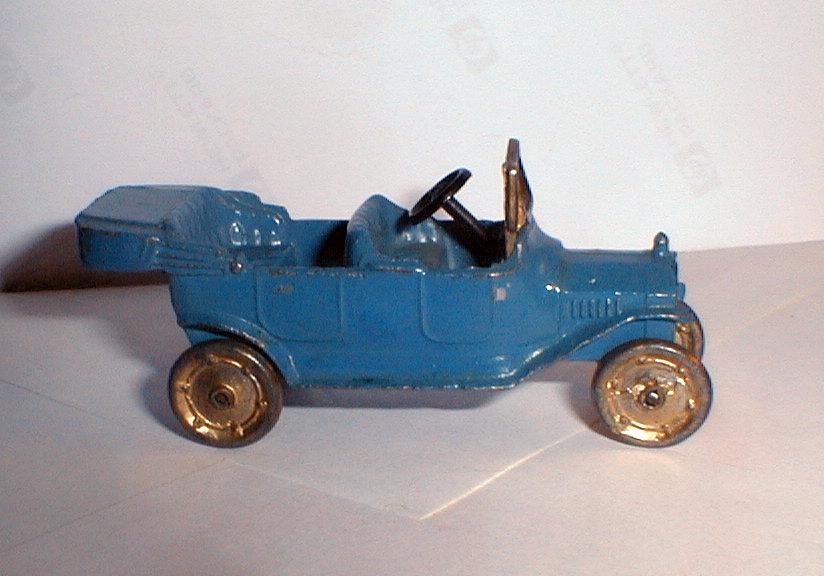
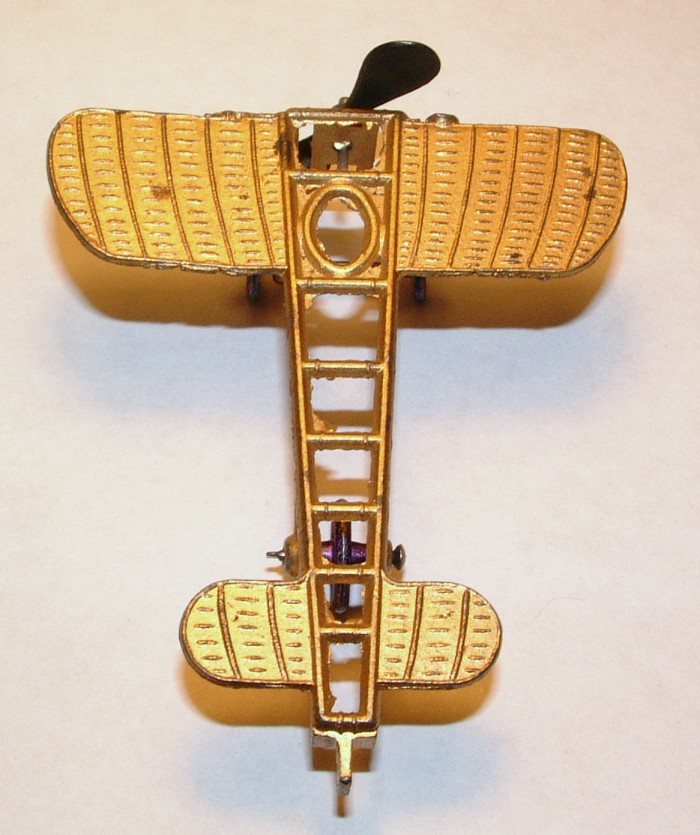
        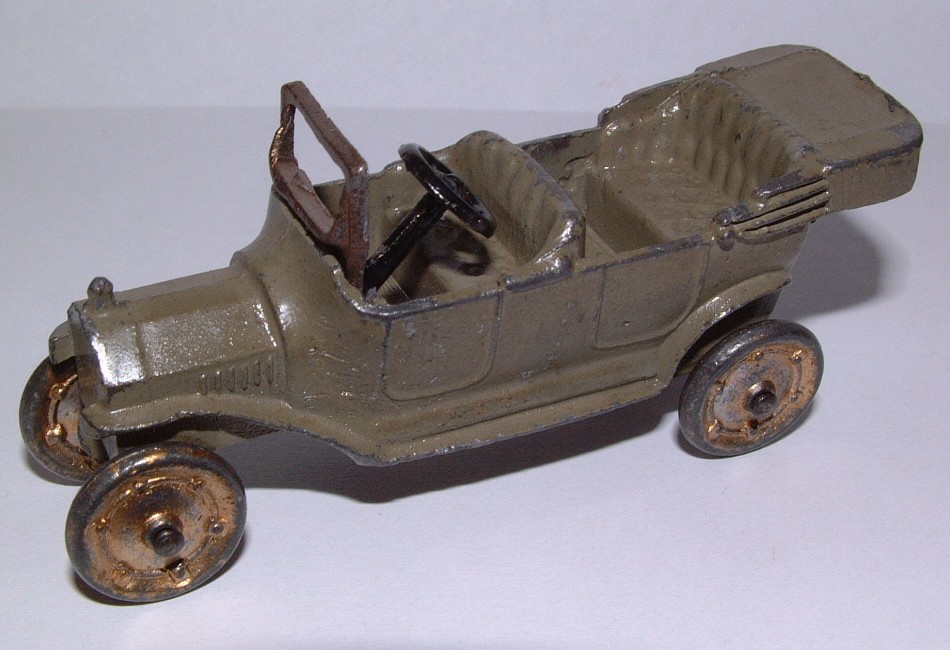  The next car to appear was the 1915 Model T Ford open tourer, followed a year later by the pick-up truck. The name "Ford" was not yet used, the vehicles being identified as "a perfect reproduction of the well-known Flivver". In 1921, the two Fords and the limousine were still the only cars in the catalogue. Clint gave 1914 as the date of introduction of the Ford tourer. However, a study of the styling of the real car shows that the toy was modelled on the 1915-16 vehicle. The web pages of the Model T Ford Club of America illustrate and describe each year's styling modifications. Up to 1914, the bonnet line of the Model T met the dashboard at right angles, but from 1915 onwards there was a cowl giving a curved join at this point. The Dowst model clearly has this curve. (Thanks to Dave Weber for pointing this out). Clint had fixed on the date of 1914 after correspondence with the factory, but as so often it seems that memories had faded and I think the styling evidence must be conclusive. The first version of the Ford tourer had headlights as part of the casting, and this model is rather rare. Clint described it as an "unsolved puzzle" and pictured it in 1981 (ref.2). His black and white photo from that article is shown above. He thought it was a contemporary copy rather than an original Tootsietoy, and said it was made before 1927, probably because he knew the provenance of that particular example. When I first put this page together, in 2005, I said that from the photograph I thought it was an original Tootsietoy, and now I am sure that is the case. A couple of other examples have come to my attention since then, which prove that the headlights are part of the casting and not some collector's modification, and I have had the opportunity to photograph and examine one of these in detail. The model with headlights is certainly from the same die as the usual version. The other major difference is that there is a mesh pattern in the casting of the grille, whereas the usual model has a flat grille. The dimensions of the models are the same, although some differences can be seen underneath, indicating that parts of the die were re-cut between the two models, taking metal off the die and adding metal to the model, for example in the area underneath the front seat-back. The first version has no casting ejector circle underneath, which was an addition to help remove the casting when the mould was opened. The model with headlights has a plated finish, which was a common finish for Dowst's early toys. This appears mostly silver with some areas gilt. The variable finish may be the result of some oxidation, or perhaps it was always like that. There are some small chips in the plating, revealing the dull grey lead underneath, but generally the model is in super condition. The wheels have a thin wash of pink paint, not unlike the purple wheels seen on the early Tootsietoy Bleriot plane (see Tootsietoys-Aircraft.html). The windscreen and steering wheel are the same as the normal model, with a gold painted dashboard/windscreen and a separately cast black painted steering column/steering wheel riveted to it. The reason for deleting the headlights and grille detail is that the grille required a separate moveable piece in the die. Perhaps this proved troublesome, or it was seen that a small loss of detail in the model would save time in opening the mould and allow faster production. Whatever the reason, the change must have happened very early in the life of the toy, probably during 1915, as the version with headlights is so uncommon. Also, the feature was not included (as far as I know) on the Ford truck introduced just a year later, although the truck pictured in the 1921 catalogue does have a mesh grille! See the catalogue page reproduced in Part 2. The plated Tootsietoy Ford Model T tourer with headlights was the original diecast toy car in the popular three-inch size, which I consider quite something, and the fact that it has not been properly described until now (2024) is remarkable. Both models changed from open-spoke to solid disc wheels around 1923. The tourer was not catalogued after 1927.     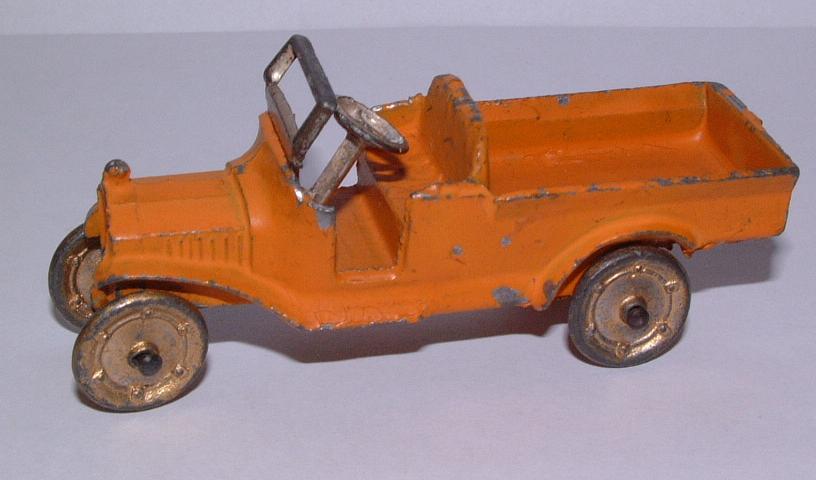 The Ford truck lasted longer than the tourer, so that late examples of the truck had TOOTSIE TOY added underneath. The dashboard/windscreen and steering column/steering wheel were usually the same as on the tourer, but the late version orange truck pictured above has this component cast as a single piece which was plated rather than painted.  Another old debate among collectors
can be settled by the styling changes to the real Model T. This
photograph shows the Model T Ford made by S.R. (Rivollet Successeurs,
previously Simon & Rivollet), of Paris (it is marked FRANCE S.R.
underneath). For many years there was some argument as to whether
the Tootsietoy or the S.R. came first, and whether
one copied the other. They are not identical, and the
S.R. is a rather better model, more finely cast and in better
proportion. Also the S.R. has the windscreen frame modelled as
part of the main casting with the separate steering wheel and column
soldered in position, whereas the Tootsietoy has a separate
dashboard/windscreen/steering wheel component which slots in
place. Comparing the S.R. model with the Model T Ford
Club of America web pages, I believe that the S.R. model is based
on a post-1917 car with a higher bonnet line whereas the Dowst model
is a 1915-16 car with the cowl but a lower bonnet line. So I
think we must give Dowst
the credit for making the first lead model of the Model T. Another old debate among collectors
can be settled by the styling changes to the real Model T. This
photograph shows the Model T Ford made by S.R. (Rivollet Successeurs,
previously Simon & Rivollet), of Paris (it is marked FRANCE S.R.
underneath). For many years there was some argument as to whether
the Tootsietoy or the S.R. came first, and whether
one copied the other. They are not identical, and the
S.R. is a rather better model, more finely cast and in better
proportion. Also the S.R. has the windscreen frame modelled as
part of the main casting with the separate steering wheel and column
soldered in position, whereas the Tootsietoy has a separate
dashboard/windscreen/steering wheel component which slots in
place. Comparing the S.R. model with the Model T Ford
Club of America web pages, I believe that the S.R. model is based
on a post-1917 car with a higher bonnet line whereas the Dowst model
is a 1915-16 car with the cowl but a lower bonnet line. So I
think we must give Dowst
the credit for making the first lead model of the Model T. Tootsietoy Trade Mark
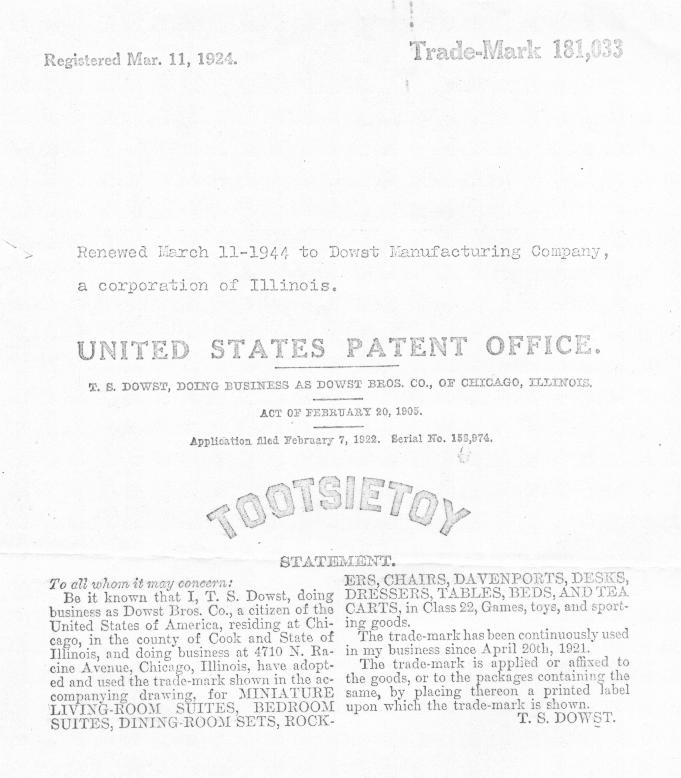 These toys had no trade name until 1922. The name
Tootsietoy was
registered as a trade mark on 11 March 1924, having been applied for on
7 February 1922. The application stated that the name had been
used continuously since 20 April 1921, but did not mention use of the
name on any of their products except doll furniture. Toots or Tootsie was the pet name of
Catherine, the illegitimate daughter of Theodore
(Ted) Dowst. Her mother was a secretary at
the Dowst factory. They only married many years later after Ted's
disapproving father had died (information from the Dowst family).
Some time
before 1925 the Tootsietoy name began to appear in catalogues and on
boxes of automotive
toys, but did not appear on the undersides of castings themselves until
1926 or 1927, and some unmarked castings were still being made after
1930. These toys had no trade name until 1922. The name
Tootsietoy was
registered as a trade mark on 11 March 1924, having been applied for on
7 February 1922. The application stated that the name had been
used continuously since 20 April 1921, but did not mention use of the
name on any of their products except doll furniture. Toots or Tootsie was the pet name of
Catherine, the illegitimate daughter of Theodore
(Ted) Dowst. Her mother was a secretary at
the Dowst factory. They only married many years later after Ted's
disapproving father had died (information from the Dowst family).
Some time
before 1925 the Tootsietoy name began to appear in catalogues and on
boxes of automotive
toys, but did not appear on the undersides of castings themselves until
1926 or 1927, and some unmarked castings were still being made after
1930.Sources of information We'll finish up this instalment with a few remarks about sources of information and then settle down to the procession of models and patent applications beginning next month. It is unfortunate that someone didn't try to make up this history a decade ago, as the passing of Theodore Dowst meant the loss of a most valuable eye-witness. A near next best was Mr.George Strobel, who joined the firm in September 1911, and retired as general manager in January 1965. His kind assistance in drawing from his rich and detailed memory has been a great help, both in conversation and in patiently answering written queries, before he passed away in March 1968. Mr Rollo Ballenger was with the firm from 1924 until 1964, and ran the New York offices (where I met him just before the Second World War, on a boyhood visit to the Blg City). He has helped with a number of details, especially on custom issues made for department stores and on bits of history relating to the change of attitude toward tiny toy replicas by such real-slze makers as Mack and Ford. He is presently living in retirement in New Jersey. Mr.George Hornbrook, quoted in an article in Mlnlature Auto magazine in January 1967, joined the firm as office manager in 1929. He had been a school teacher previously, and had taught the father of the present Shure brothers before being brought to the firm to "keep an eye on the office" for the Shures, who had left the management to Theodore Dowst after buying the firm out. Mr.Hornbrook is now living in Chicago in retirement, and recalls many of the people and events with great clarity, though has little interest in or memory of the models themselves. The piece in Miniature Auto says that it was George Hornbrook who coined the name 'Doodlebug' (see part 6), and when challenged about the simplification and lack of realism in the later pre-war models said 'We make toys for doodling, not display' (ref.16). The youngest of the Shure brothers presently at the plant, Dick, has been very helpful in loaning me the company's file of catalogues, dating from 1921, and in supplying myriad details. Mr.J.N.Shure, father of the present management, is retired in Florida. Many employees still at the plant have been there for up to 40 years, and have helped with bits and pieces of data, and many are second or third generation employees of the firm. Mr.Louis Hertz is an author presently completing a book on the subject of old toy cars (ref.5), and has paralleled many of my efforts. He has willingly swapped much data with me, and steered me toward other sources. The U.S. Patent Office has provided pertinent documents from their files. Much of the information in the subsequent instalments of this history would have been unobtainable were it not for help from these people, but I'll take the blame for any goofs. The
Dowst v.Pressman legal action
  Mention of Louis Hertz's
book (ref.5) leads me to another digression,
which nonetheless does relate to
the Model T Ford Touring Car, in fact I can't think why Clint Seeley
didn't cover this in the original article. In a footnote on page
231 of his
book, Louis Hertz refers to the Dowst v.Pressman legal action of 1927,
as if the reader should know exactly what he is talking about.
This sort of unexplained aside, together with his rather indigestible
writing style, make the book very heavy going and not one I would
recommend seeking out now after more than forty years. However,
Clint Seeley refers to the same case in his 1981 article (ref.2) with a little
more clarity. Mention of Louis Hertz's
book (ref.5) leads me to another digression,
which nonetheless does relate to
the Model T Ford Touring Car, in fact I can't think why Clint Seeley
didn't cover this in the original article. In a footnote on page
231 of his
book, Louis Hertz refers to the Dowst v.Pressman legal action of 1927,
as if the reader should know exactly what he is talking about.
This sort of unexplained aside, together with his rather indigestible
writing style, make the book very heavy going and not one I would
recommend seeking out now after more than forty years. However,
Clint Seeley refers to the same case in his 1981 article (ref.2) with a little
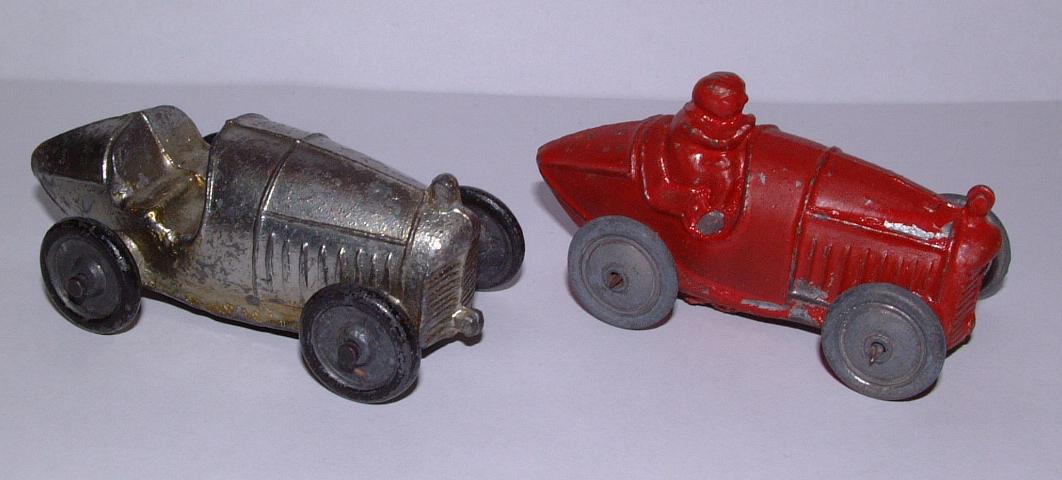
more clarity.It seems that Dowst brought an action for patent infringement involving two slush cast copies of Tootsietoys, which Hertz identifies as Pressman no.116 (a copy of the Model T Ford Tourer) and Pressman no.114 (a copy of the Tootsie no.23 Racer introduced in 1926 and described in part 3 of this article). The slush cast Ford had the addition of single figures cast in the front and rear seats, and the trial judge held that this was sufficient to make it an original design that could not be confused with the Tootsietoy. Pressman were also successful in arguing that their racing car was not a copy of the Tootsietoy no.23 but that both were derived from an earlier cast metal miniature, presumably the slush cast Kansas Toy (see photo). Actually the Pressman racer is much more like the Kansas Toy than the Tootsie. The Pressman toys are those that today's collectors will find listed in O'Brien's book (ref.6) as the products of the Mid-West Metal Novelty Manufacturing Company. A contemporary mention of this firm in a trade magazine is reproduced in O'Brien's, but the toy illustrated clearly has plain disc wheels with black painted "tyres" in the style of CAW or Kansas Toys. The toys with Pressman style wheels (unpainted and with a suggestion of a rim between wheel and tyre) may in fact have nothing to do with the Mid-West firm. Pressman copied several other early Tootsies as well, some of which are photographed in part 2 of this article. Pressman was probably the distributor rather than manufacturer of the toys, and the firm is still in existence (see http://www.pressmantoy.com/). Louis Hertz also mentions that the Pressman toy cars were included in their catalogue for 1927 (page 241 in ref.5). If any reader has this catalogue, or an extract from it showing the cars, I would be delighted to see it, please e-mail me. References (1) "From Line-O-Type to the Funnies - The Birth of Tootsietoys" in Automobile Year Book of Models no.3, Editions 24 heures, Lausanne, 1984. (2) "To Tell the True T.T." in Modellers' World magazine, Vol.10 no.4 and Vol.11 no.1, July and October 1981. (3) "Early Tootsietoy Aircraft" in Modellers' World magazine, Vol.3 no.2, Jan.1974. (4) The Book of Penny Toys by David Pressland, New Cavendish Books, 1991. (5) The Complete Book of Building and Collecting Model Automobiles by Louis H.Hertz, Crown Publishers Inc., New York, 1970. (6) Collecting Toy Cars & Trucks by Richard O'Brien, Krause Publications, 2nd edition 1997. This is the best reference book for American slush cast automotive toys. I believe there are now third and fourth editions as well. (16) "The Tootsietoy Era" by Arthur E.Anderson, Miniature Auto December 1966 and January 1967. |

© Robert Newson